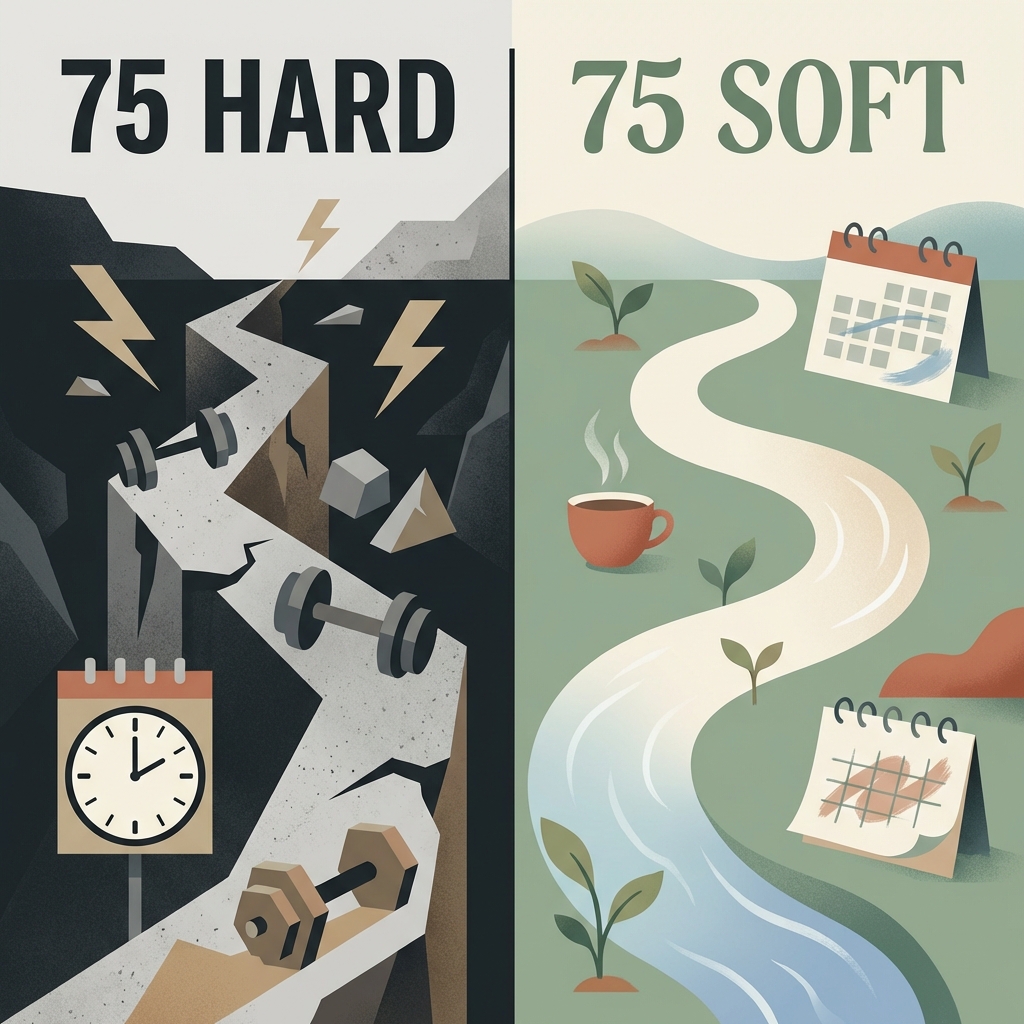
Since 75 Hard went viral, the fitness community has spawned dozens of variations: 75 Soft, 75 Medium, the Mom Edition, the Beginner's 75, and countless personal adaptations. It can feel overwhelming trying to figure out which is "legitimate" and which is right for you.
Here's the truth: there's no official governing body for 75-day challenges. Beyond 75 Hard (which has a specific creator), these variations are community-driven evolutions. Let's map out the landscape so you can make an informed choice—or create your own variation with confidence.
The Challenge Spectrum: From Soft to Hard
Think of 75-day challenges as existing on a spectrum of intensity and rigidity:
| Challenge | Intensity | Flexibility | Best For |
|---|---|---|---|
| Beginner's 75 | ★☆☆☆☆ | Maximum | Complete beginners, recovery |
| 75 Soft | ★★☆☆☆ | High | Sustainable habit building |
| 75 Medium | ★★★☆☆ | Moderate | More structure, less extreme |
| 75 Hard | ★★★★★ | None | Mental toughness testing |
Each position on this spectrum represents a tradeoff between challenge intensity and sustainable completion. There's no universally "best" position—only what's best for you right now.
75 Medium Explained
75 Medium emerged for people who find 75 Soft too flexible but 75 Hard too extreme. It's a middle ground that maintains more structure while avoiding the most problematic elements of 75 Hard.
Common 75 Medium Rules
Since there's no official version, 75 Medium varies, but the most common interpretation includes:
- One 45-minute workout daily (like 75 Soft, not two like 75 Hard)
- Strict nutrition approach (90/10 rather than 80/20, more defined than 75 Soft)
- No alcohol (matching 75 Hard's zero-tolerance approach)
- 3 liters of water daily (same as 75 Soft)
- 10 pages of reading (usually non-fiction, like 75 Hard)
- Optional progress photos (unlike 75 Hard's requirement)
- No restart rule (keeping 75 Soft's grace approach)
The Key Difference
75 Medium typically removes alcohol entirely (like 75 Hard) while keeping 75 Soft's single daily workout and no-restart policy. It's stricter on indulgences but gentler on physical demands and failure consequences.
Who 75 Medium Is For
- People who completed 75 Soft and want more challenge
- Those who want to eliminate alcohol but can't sustain two daily workouts
- Anyone who found 75 Soft too easy but knows 75 Hard won't work
- People preparing to eventually attempt 75 Hard
75 Soft Variations
Even within "75 Soft," there's variation in how people interpret and apply the rules. Here are the most common approaches:
Standard 75 Soft
The most commonly referenced version includes:
- One 45-minute workout daily (active recovery day allowed once per week)
- "Eat well" with flexibility (typically interpreted as 80/20)
- One alcoholic drink per week allowed (at social events)
- 3 liters of water daily
- 10 pages of reading daily (any genre)
- No restart if you miss a day
Strict 75 Soft
A slightly more structured interpretation:
- All standard 75 Soft rules
- No alcohol at all (stricter than standard)
- 90/10 eating approach instead of 80/20
- Progress photos recommended (not required)
Relaxed 75 Soft
A gentler version for those who need more flexibility:
- 30-minute workouts (instead of 45)
- Two active recovery days per week
- Focus on adding healthy habits rather than restricting
- Audiobooks count as reading

Niche Editions
Beyond the main spectrum, specific communities have created tailored versions:
The Mom Edition
Popularized through blogs and social media, this variation acknowledges the realities of parenting:
- Workouts can be split (e.g., two 22-minute sessions)
- Active play with kids counts as exercise
- Audiobooks count (for tired evening hours)
- Flexibility around meal timing and kid-friendly food
- Grace for interrupted sleep and sick days
The Chronic Illness 75
Adapted for those managing health conditions:
- Movement based on daily capacity (10-45 minutes)
- Hydration adjusted to medical guidance
- Rest days as needed without guilt
- Focus on consistency over intensity
- Mental wellness emphasis alongside physical
The Mental Health First 75
Designed for those prioritizing psychological wellbeing:
- Standard physical rules from 75 Soft
- Added: 5-10 minute daily meditation
- Added: Daily gratitude practice
- Journaling encouraged (with prompts)
- One complete rest day per week mandatory
The Minimalist 75
For those who prefer simplicity:
- Move your body for 30+ minutes
- Eat something nutritious at each meal
- Drink enough water (personal target)
- Learn something new each day
- That's it. No complicated rules.
Creating Your Own Variation
You have full permission to create a personalized 75-day challenge. Here's how to design one that works:
Step 1: Identify Your Core Goals
What do you actually want to achieve? Better fitness? Mental clarity? Reduced alcohol consumption? Weight management? Your goals should drive your rules.
Step 2: Keep the Non-Negotiable Elements
Whatever variation you create, these elements should remain:
- Daily movement (even if modified for your capacity)
- Nutritious eating (however you define it)
- Hydration (adjusted for your body and climate)
- Mental growth (reading, learning, or reflection)
- Consistency (75 days of intentional effort)
Step 3: Set Realistic Parameters
Be honest about your life constraints:
- How much time can you realistically dedicate to exercise?
- What food restrictions are sustainable for you?
- Are there upcoming events that require flexibility?
- What's your current fitness baseline?
Step 4: Build in Grace
The most successful custom challenges include:
- A "minimum viable day" definition for tough days
- No restart rule (progress accumulates)
- Built-in rest or flexibility days
- Room for life to happen
Sample Custom Challenge Template
My 75-Day Challenge:
• Movement: [YOUR DURATION] minutes, [YOUR FREQUENCY]
• Nutrition: [YOUR APPROACH]
• Hydration: [YOUR TARGET]
• Learning: [YOUR METHOD]
• Flexibility: [YOUR GRACE RULES]
• Failure policy: Continue from today, don't restart
Is It "Legitimate" to Modify?
This question comes up constantly, and here's my definitive answer: Yes.
The only challenge with a specific creator and "official" rules is 75 Hard. Everything else—including 75 Soft—emerged organically from community adaptation. There's no 75 Soft certification body or trademark holder who can tell you you're "doing it wrong."
What Matters Is...
- Intentionality: You're committing to 75 days of focused self-improvement
- Challenge: The rules should stretch you beyond your current defaults
- Consistency: You're showing up daily, even when modified
- Sustainability: You can maintain or exceed these habits after Day 75
If your variation meets these criteria, it's "legitimate" regardless of whether it matches someone else's interpretation.
The goal isn't to complete a specific set of rules someone else created. It's to become someone who shows up for themselves every day. How you do that is your choice.
How to Choose Your Variation
Use this decision framework:
1. Assess Your Starting Point
- New to fitness challenges? Start with Beginner's 75 or Relaxed 75 Soft
- Moderately active? Standard 75 Soft is likely appropriate
- Already disciplined? Consider 75 Medium or Strict 75 Soft
- Previous challenge experience? You might be ready for more intensity
2. Consider Your Life Constraints
- Demanding job/caregiving? Choose maximum flexibility
- Upcoming travel or events? Build in social allowances
- Health considerations? Prioritize the appropriate niche edition
- Clear schedule? You can choose more structured options
3. Evaluate Your Goals
- Sustainable habit building? Stay on the Soft side of the spectrum
- Specific fitness goals? Customize your workout requirements
- Mental toughness testing? Move toward Medium or Hard
- Recovery or rebuild? Use a gentler variation with mental health focus
4. Start and Adjust
Here's permission you might need: You can adjust mid-challenge. If you start with 75 Medium and realize it's not sustainable, shifting to 75 Soft isn't failure—it's intelligent adaptation. The goal is completing 75 days of intentional improvement, not proving you can maintain unsustainable rules.
Ready to start? If you've chosen 75 Soft, explore our complete rules guide. If you're comparing to 75 Hard directly, read our detailed comparison. Or learn how to customize 75 Soft for your specific goals.