James Clear's Atomic Habits has sold over 15 million copies for good reason: it distills decades of behavioral science into actionable principles. What many people don't realize is that 75 Soft is essentially these principles in action—a structured 75-day laboratory for building the habits that change your life.
When I approached my 75 Soft journey through the lens of Atomic Habits, everything clicked. The challenge wasn't just about drinking water and exercising—it was about rewiring my identity through small, consistent actions. Let me show you how to run this experiment for yourself.
The Habit Loop Explained
Every habit follows a neurological loop with four stages: cue, craving, response, and reward. This loop is automatic—your brain runs it without conscious thought, which is both the power and the danger of habits.
The Four Stages of Habit
Cue: The trigger that initiates the behavior (seeing your water bottle)
Craving: The motivational force (wanting to feel hydrated and healthy)
Response: The actual habit (drinking the water)
Reward: The satisfaction (feeling refreshed, checking it off your list)
75 Soft provides the structure, but understanding this loop lets you engineer each habit for maximum stickiness. The goal isn't just to complete 75 days—it's to make these behaviors so automatic that they continue long after the challenge ends.
The Four Laws of Behavior Change
James Clear translates the habit loop into four practical laws for building good habits (and their inverses for breaking bad ones):
- Make it obvious (Cue)
- Make it attractive (Craving)
- Make it easy (Response)
- Make it satisfying (Reward)
Let's apply each law to the four core habits of 75 Soft: exercise, nutrition, hydration, and reading.
Law 1: Make It Obvious
The most powerful cue is the one you can't miss. Many habits fail not because of lack of motivation, but because the cue is invisible. Here's how to make your 75 Soft habits unmissable:
For Exercise
- Implementation intention: "I will exercise at [TIME] in [LOCATION]"
- Visual cue: Lay out workout clothes the night before
- Calendar blocking: Schedule workouts like non-negotiable meetings
- Trigger stacking: Put running shoes by the coffee maker
For Hydration
- Visual cue: Keep a large water bottle on your desk at all times
- Time-based triggers: Drink a glass upon waking, before each meal, and before bed
- Location cues: Place water bottles in every room you frequent
For Reading
- Placement: Put your book on your pillow so you see it before bed
- Removal of friction: Keep your phone charger across the room
- Visual prominence: Stack your reading pile where you can't miss it
For Nutrition
- Kitchen design: Put healthy foods at eye level in the fridge
- Prep visibility: Keep prepped vegetables in clear containers
- Strategic shopping: Only buy what supports your eating goals
Law 2: Make It Attractive
We are drawn to behaviors that promise reward. The more attractive a habit feels, the more likely we are to pursue it. Here's how to add appeal to your 75 Soft habits:
Temptation Bundling
Pair a habit you need to do with something you want to do:
- Only listen to your favorite podcast during workouts
- Only watch your guilty-pleasure show while on the treadmill or stretching
- Only drink your fancy tea while reading your 10 pages
- Only enjoy your special coffee after completing your morning hydration goal
Social Attractiveness
Humans are social creatures. We naturally adopt behaviors of the groups we belong to:
- Join a 75 Soft community on Facebook, Reddit, or Discord
- Find an accountability partner doing the challenge
- Share progress (if comfortable) with supportive friends
- Follow people on social media who model the habits you want
"One of the most effective things you can do to build better habits is to join a culture where your desired behavior is the normal behavior." — James Clear, Atomic Habits
Reframe the Narrative
Change "I have to" to "I get to":
- "I get to move my body today" (not "have to exercise")
- "I get to nourish myself with good food" (not "have to diet")
- "I get to learn something new from my book" (not "have to read")
Law 3: Make It Easy
The Law of Least Effort states that we naturally gravitate toward options requiring the least work. This isn't laziness—it's efficiency. Work with this tendency, not against it.
Reduce Friction for Good Habits
- Exercise: Have a home workout option for busy days; keep gym bag packed
- Hydration: Buy multiple water bottles so one is always within reach
- Reading: Keep your book accessible; use a Kindle for portability
- Nutrition: Meal prep on weekends; keep healthy snacks visible
Add Friction for Bad Habits
- Delete social media apps (you can still access via browser if needed)
- Keep junk food out of the house entirely
- Put your phone in another room during reading time
- Unsubscribe from food delivery services during the challenge
Prime Your Environment
Spend 10 minutes each evening "resetting" your environment for the next day: lay out workout clothes, fill water bottles, place your book on your pillow, prep tomorrow's healthy breakfast. This small investment makes tomorrow's habits effortless.
Law 4: Make It Satisfying
What is rewarded is repeated. What is punished is avoided. The challenge is that many healthy habits have delayed rewards—you won't see fitness results for weeks. Here's how to create immediate satisfaction:
Track Your Progress
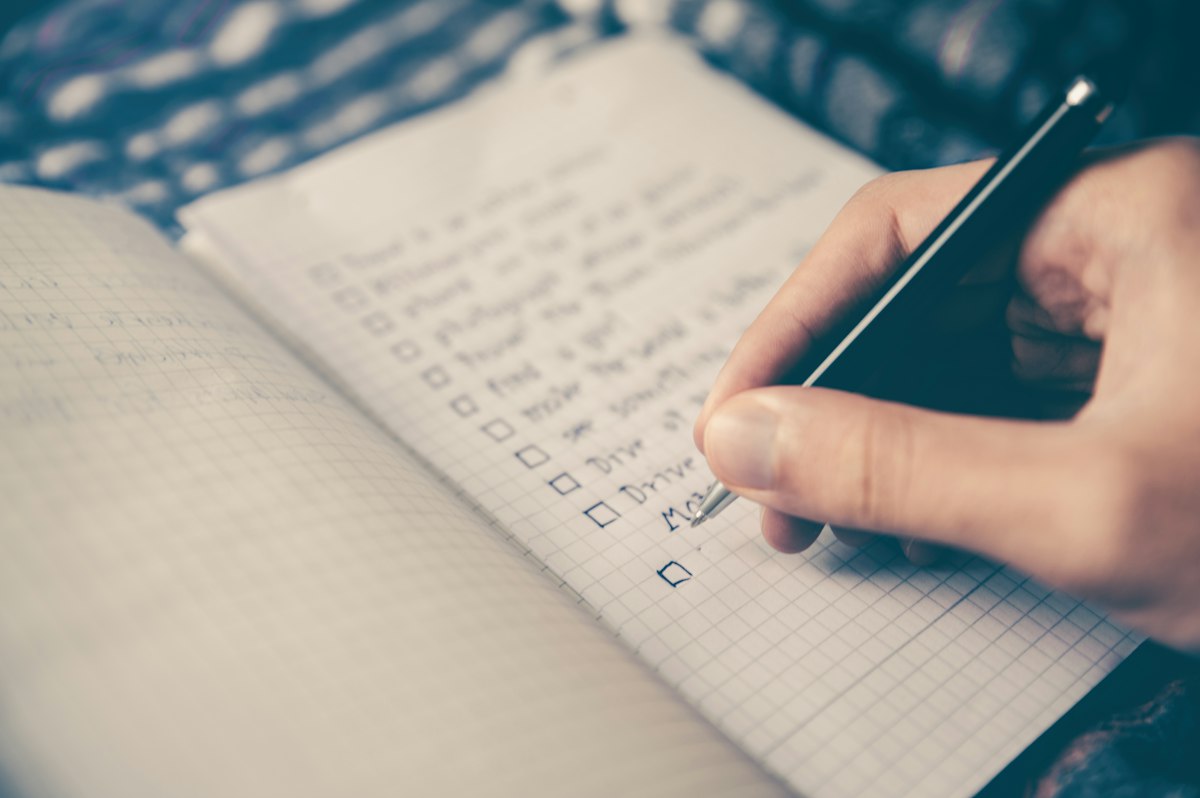
The act of tracking itself is satisfying. Each checkmark is a small reward:
- Use a printed tracker with satisfying boxes to check
- Track in a habit app with visual streaks
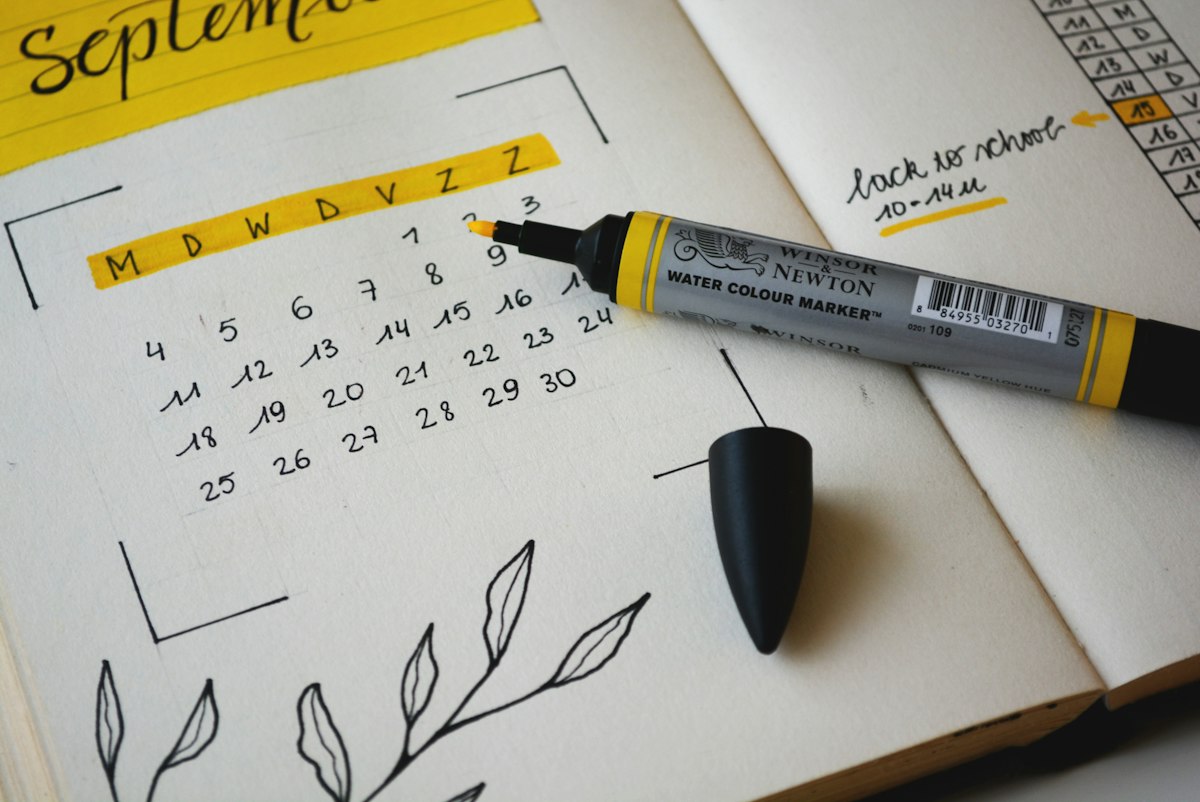
- Use a bullet journal with creative layouts
- Mark completed days on a wall calendar—the "don't break the chain" method
Celebrate Small Wins
Immediately after completing a habit, give yourself a tiny celebration:
- Say "Yes!" out loud after finishing your workout
- Do a small fist pump after drinking your water goal
- Take a moment of gratitude after completing your reading
- Share a win in your accountability group
Never Miss Twice
The golden rule of habit maintenance: missing once is an accident; missing twice is the start of a new habit. If you have an imperfect day, recommit immediately. This is where 75 Soft's flexibility shines—there's no restart penalty, just the commitment to show up again.
Identity-Based Habits: The Deepest Change
Most people approach habits with outcome-based goals: "I want to lose 20 pounds." Atomic Habits teaches that identity-based change is more powerful: "I am someone who takes care of my body."
Here's the shift for 75 Soft:
- Outcome-based: "I want to complete 75 Soft" → Identity-based: "I am someone who moves daily"
- Outcome-based: "I want to drink more water" → Identity-based: "I am someone who prioritizes hydration"
- Outcome-based: "I want to eat better" → Identity-based: "I am someone who nourishes my body"
- Outcome-based: "I want to read more" → Identity-based: "I am a reader"
"Every action you take is a vote for the type of person you wish to become." — James Clear, Atomic Habits
Each day of 75 Soft, you're casting votes for your new identity. By Day 75, you've cast hundreds of votes for being someone who exercises, hydrates, eats well, and reads. That identity doesn't disappear when the challenge ends—it's who you've become.
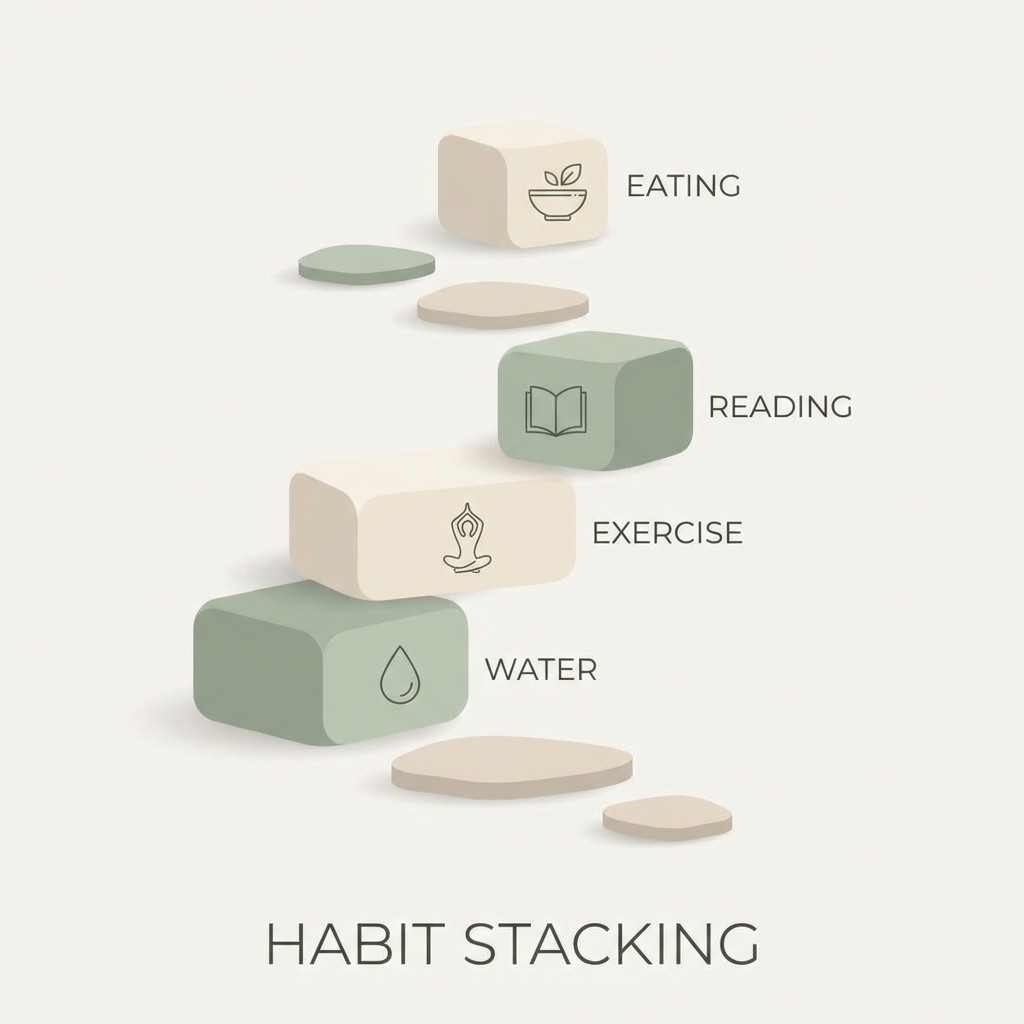
Habit Stacking for 75 Soft
Habit stacking uses existing habits as cues for new ones. The formula: "After I [CURRENT HABIT], I will [NEW HABIT]."
Morning Stack Example
- After I turn off my alarm, I will drink one glass of water (hydration)
- After I drink water, I will put on my workout clothes (exercise prep)
- After I put on workout clothes, I will do my morning movement (exercise)
- After my workout, I will prepare a healthy breakfast (nutrition)
Evening Stack Example
- After I finish dinner, I will review my water intake and drink remaining ounces
- After I complete hydration, I will prepare tomorrow's workout clothes
- After I prep tomorrow, I will get into bed with my book
- After I read 10 pages, I will journal one gratitude and go to sleep
The Two-Minute Rule
When building a new habit, start with the "gateway habit"—a version that takes two minutes or less:
- "Exercise for 45 minutes" becomes "Put on my workout clothes"
- "Read 10 pages" becomes "Read one page"
- "Eat healthy" becomes "Eat one vegetable"
- "Drink 3 liters" becomes "Fill my water bottle"
The point isn't that these tiny actions are sufficient—it's that they're starters. Once you've put on your workout clothes, you're much more likely to actually exercise. The Two-Minute Rule overcomes the moment of inertia that stops most habits before they start.
On Difficult Days
When motivation is lowest, default to the Two-Minute version. A 10-minute walk still counts as movement. Reading 2 pages still counts as reading. The goal is never zero. Even the smallest action maintains the habit loop and your identity as someone who shows up.
Environment Design: The Ultimate Leverage
Your environment is more powerful than your willpower. People who appear to have excellent self-control often just have better-designed environments. Here's how to design yours for 75 Soft success:
The Kitchen
- Clear countertops except for a fruit bowl
- Pre-washed vegetables at eye level in the fridge
- Healthy proteins prepped and ready
- No junk food in the house—don't test willpower when it's unnecessary
The Living Space
- Water bottles visible in every room
- Exercise equipment accessible (yoga mat unrolled, weights visible)
- TV remote stored away; book placed prominently
- Phone charging station away from the couch
The Bedroom
- Phone charges across the room (not bedside)
- Book on pillow or nightstand
- Workout clothes laid out for morning
- Water glass ready for morning hydration
Want to maintain momentum throughout your journey? Read our guide on staying motivated for the full 75 days or explore 75 days of journaling prompts to deepen your self-awareness.