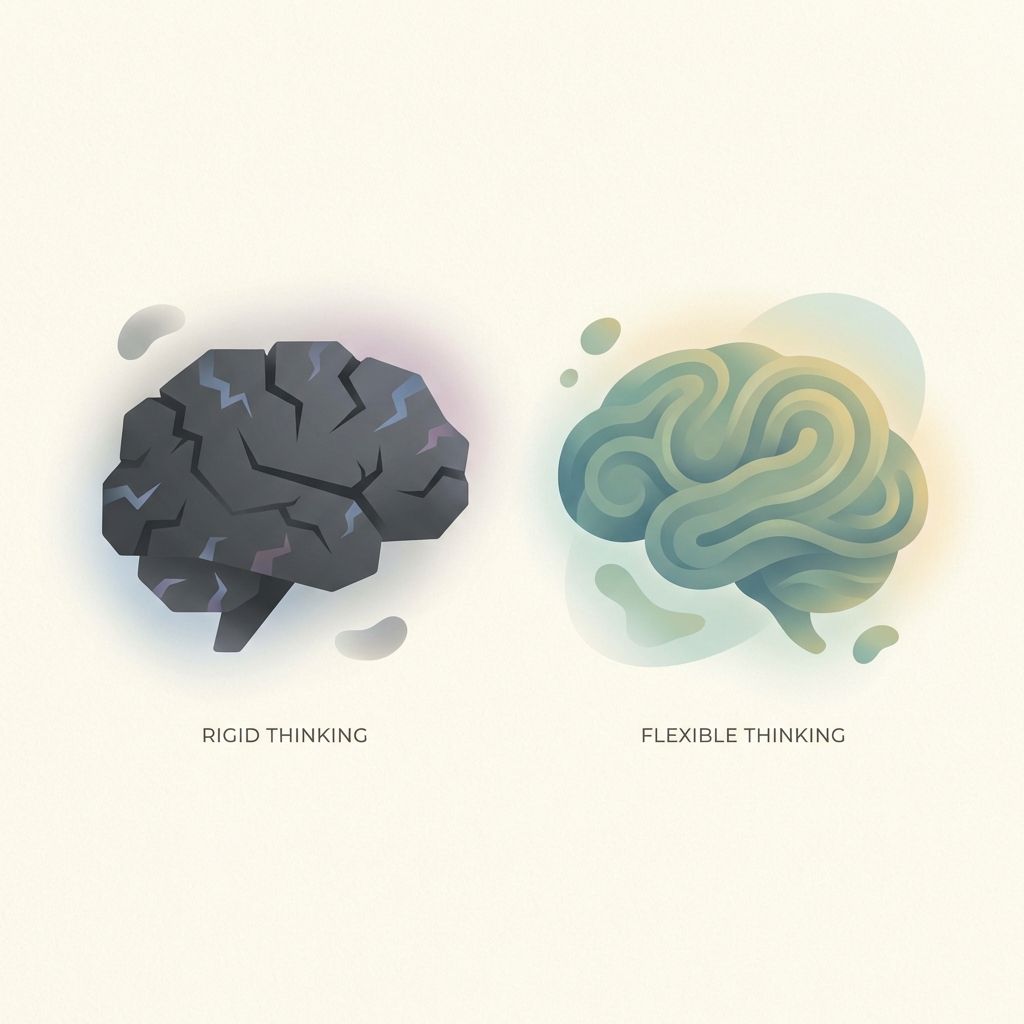
The promise of 75 Soft is beautifully simple: build discipline through consistent daily habits for 75 days. But there's a nuance that often gets lost in the excitement of starting a new challenge—the difference between healthy discipline and unhealthy obsession. One strengthens you. The other consumes you. Understanding where that line exists, and how to stay on the right side of it, may be the most important skill you develop during this journey.
Mental Health Note
This article discusses mental health topics including anxiety, eating disorders, and obsessive behaviors. If you're currently struggling with any of these, please consult a mental health professional before starting any wellness challenge. Your wellbeing matters more than any program.
The Thin Line: Discipline vs. Obsession
At first glance, discipline and obsession can look remarkably similar. Both involve consistent focus on goals. Both require prioritizing certain behaviors. Both may involve saying "no" to distractions. But beneath the surface, they operate on entirely different psychological foundations—and lead to very different outcomes.
What Healthy Discipline Looks Like
Healthy discipline is characterized by:
- Flexibility within structure: You can adapt when life requires it without distress
- Internal motivation: You're driven by personal values, not fear or shame
- Enhanced wellbeing: The practice makes you feel better overall
- Maintained relationships: Your habits don't isolate you from others
- Rest without guilt: You can take breaks without anxiety
- Identity beyond the habit: You are more than your challenge performance
- Self-compassion after slip-ups: Imperfection is met with kindness
What Unhealthy Obsession Looks Like
Unhealthy obsession, in contrast, manifests as:
- Rigid inflexibility: Any deviation causes significant distress
- Fear-based motivation: Driven by fear of failure, shame, or self-criticism
- Deteriorating wellbeing: Anxiety, exhaustion, or unhappiness increase
- Social isolation: Avoiding events or people that might "interfere"
- Guilt-laden rest: Unable to truly relax even on designated rest days
- Identity fusion: Your worth becomes tied to perfect compliance
- Self-attack after imperfection: Harsh internal criticism and shame
Discipline says, "I choose this because it serves me." Obsession says, "I must do this or I'm a failure." The difference isn't in the behavior—it's in the relationship with the behavior.
Why Fitness Challenges Can Trigger Mental Health Issues
Structured fitness challenges, even gentle ones like 75 Soft, can inadvertently activate psychological vulnerabilities in certain individuals. Understanding why this happens can help you protect yourself.
The All-or-Nothing Framework
Many challenges are inherently binary: you either completed the day or you didn't. This structure can reinforce all-or-nothing thinking—a cognitive distortion associated with anxiety, depression, and eating disorders. While 75 Soft mitigates this with its no-restart rule, the daily tracking still frames each day as "compliant" or "non-compliant."
External Validation Triggers
Sharing progress on social media—common in 75 Soft communities—can shift motivation from internal to external. If your sense of accomplishment depends on likes, comments, or community approval, you become vulnerable to their absence. This external validation cycle can fuel anxiety and people-pleasing behaviors.

The Moralization of Behaviors
Wellness culture often attaches moral value to health behaviors. Eating "well" is "good." Skipping a workout is "bad." This moralization transforms routine choices into character judgments, creating unnecessary shame and guilt around normal human variance.
Control Mechanisms
For individuals dealing with stress, anxiety, or past trauma, structured challenges can become a way to feel in control of an unpredictable world. While some control is healthy, using rigid routines to manage anxiety can backfire—creating more anxiety when the routine is disrupted.
How 75 Soft Protects Mental Health
75 Soft was designed with awareness of the psychological pitfalls of extreme challenges. Several features intentionally protect participant mental health:
Built-In Mental Health Safeguards
- No restart rule: One slip doesn't erase all progress, reducing catastrophic thinking
- 80/20 nutrition: Built-in flexibility prevents restrictive eating patterns
- Active recovery day: Permission to rest without "breaking" the challenge
- Social drinking allowed: Doesn't require isolation from social events
- "Progress over perfection" philosophy: Emphasizes journey, not flawless execution
According to Penn State Health experts, the gentler approach of 75 Soft allows people to "make healthier choices—something that's easier for people to manage for the long haul." This sustainability reduces the psychological pressure that leads to burnout and shame spirals.
The Psychology of "Good Enough"
75 Soft implicitly teaches a concept psychologists call "satisficing"—the acceptance of "good enough" rather than demanding perfection. Research shows that satisficers (those who accept good enough) tend to be happier and less anxious than maximizers (those who demand the best possible outcome).
By building flexibility into the rules, 75 Soft trains participants in satisficing: an 80% effort day still counts. A modified workout still counts. A less-than-ideal reading session still counts. This psychological reframing can extend far beyond the challenge itself.
Warning Signs Your Challenge Has Become Unhealthy
Even with 75 Soft's protective features, some participants may slip into unhealthy patterns. Self-awareness is your best defense. Watch for these warning signs:
Behavioral Warning Signs
- Exercising when sick or injured rather than resting
- Declining social invitations to maintain the challenge
- Lying about challenge compliance to others or yourself
- Obsessively tracking, counting, or measuring
- Exercising at inappropriate times (late at night, before dawn) to "fit it in"
- Restricting food beyond the 80/20 guideline
- Compensating for "indulgences" with extra exercise or restriction
Emotional Warning Signs
- Persistent anxiety about the challenge throughout the day
- Guilt that lingers for hours or days after imperfect performance
- Feeling worse about yourself than before starting
- Irritability when challenge routines are disrupted
- Dread rather than anticipation about daily activities
- Emotional swings based on challenge compliance
- Feeling like a failure despite objective progress
Cognitive Warning Signs
- Intrusive thoughts about food, exercise, or compliance
- All-or-nothing thinking ("I ate one cookie, the day is ruined")
- Catastrophizing about missed components
- Comparing yourself negatively to others' challenge journeys
- Black-and-white labeling of foods as "good" or "bad"
- Identity becoming "the person doing 75 Soft"
Immediate Attention Needed
If you're experiencing thoughts of self-harm, severe restriction of food or fluids, exercising to the point of injury, or distress that interferes with daily functioning, please pause the challenge and seek professional support immediately. No challenge is worth your mental health.
Escaping the Perfectionism Trap
Perfectionism is one of the most common mental health challenges that can corrupt a wellness journey. Even flexible challenges can become rigid in perfectionist hands.
How Perfectionism Hijacks 75 Soft
Perfectionists tend to:
- Interpret 80/20 as "80% perfect, 20% acceptable"—still demanding perfection
- View "active recovery" as requiring a specific, optimized routine
- Compare their imperfect execution to others' highlight reels
- Feel like they're "cheating" when using the built-in flexibility
- Set additional rules beyond the challenge requirements
- Dismiss progress because it wasn't "perfect"
Strategies for Perfectionism Recovery
- Intentionally practice imperfection: Choose one day per week to do a "minimum viable" version of each habit
- Celebrate effort, not outcomes: "I showed up" is the win, regardless of performance
- Use the flexibility: Actively use the 20% indulgence and social drinking allowance
- Avoid comparison: Stay off social media challenge communities if they trigger comparison
- Reframe "failure": Every imperfect day is data, not disaster
- Practice self-compassion: Speak to yourself as you would to a friend
The goal of 75 Soft isn't to become perfect. It's to become consistent. And consistency, unlike perfection, includes room for being human.
Managing Challenge-Related Anxiety
Some degree of performance anxiety is normal when taking on a new challenge. But when anxiety becomes persistent or overwhelming, it undermines the very wellness you're trying to build.
Common Anxiety Triggers in 75 Soft
- Fear of "falling behind" or losing progress
- Worry about fitting all requirements into busy days
- Social anxiety about explaining the challenge to others
- Anticipatory anxiety about upcoming challenges (travel, events)
- Fear of judgment from the community or self

Anxiety Management Strategies
- Plan ahead: Know your modified approach for challenging days before they arrive
- Create buffers: Don't schedule requirements back-to-back without flexibility
- Use grounding techniques: When anxiety spikes, return to the present moment
- Remember the "why": Anxiety often disconnects us from our values—recall why you started
- Distinguish productive from unproductive worry: Can you act on this concern right now?
- Limit tracking: Obsessive monitoring increases anxiety; track minimally
- Practice acceptance: Some days won't go as planned—that's part of life
Eating Disorder History: Special Considerations
If you have a history of anorexia, bulimia, binge eating disorder, orthorexia, or other disordered eating patterns, 75 Soft requires extremely careful consideration—or may not be appropriate at all.
Critical Warning
Any structured program involving food rules and exercise requirements can trigger eating disorder relapse or onset. If you have eating disorder history, consult your treatment team before starting 75 Soft. Many treatment professionals advise against any challenge-based wellness programs during recovery.
Why 75 Soft May Be Risky for ED Recovery
- Food rules (even flexible ones): The 80/20 approach still involves categorizing foods and monitoring eating
- Daily exercise requirements: Can reinforce compulsive exercise patterns
- Tracking and measurement: May trigger obsessive behaviors
- Progress photos: Can fuel body checking and appearance obsession
- Challenge terminology: The concept of "challenge" itself may activate competitive restriction
If You Choose to Proceed (With Professional Guidance)
If your treatment team approves participation, consider these modifications:
- Skip the nutrition component entirely—focus only on movement and reading
- Avoid progress photos or take them with therapeutic guidance only
- Don't track food in any way—not calories, not "healthy vs. unhealthy"
- Keep your treatment team informed throughout
- Establish clear stopping criteria before you begin
- Have accountability partners who understand your history
Building Discipline Without Self-Punishment
The healthiest approach to 75 Soft—and to discipline in general—is one based on self-compassion rather than self-punishment. Research consistently shows that self-compassion produces better long-term behavior change than self-criticism.
The Self-Compassion Framework
Dr. Kristin Neff's research identifies three components of self-compassion:
- Self-kindness: Treating yourself with warmth rather than harsh judgment
- Common humanity: Recognizing that imperfection is part of shared human experience
- Mindfulness: Holding difficult emotions in balanced awareness rather than over-identifying
Applying Self-Compassion to 75 Soft
- When you miss a workout: "This is hard. Everyone struggles sometimes. I'll try again tomorrow."
- When you overeat: "I'm human. Many people struggle with this. I can return to balance."
- When you feel like a failure: "This feeling is painful. It's normal to feel disappointed. This doesn't define me."
The Paradox of Self-Compassion
Many people fear that self-compassion will make them lazy or undisciplined. Research shows the opposite: self-compassionate people are more likely to persist after failure, take responsibility for mistakes, and maintain motivation over time. Kindness builds resilience; cruelty builds fragility.
When to Pause or Stop the Challenge
Knowing when to stop is as important as knowing how to start. Quitting isn't failure when the alternative is harm to your mental health.
Valid Reasons to Pause
- Significant life stressor (grief, job loss, relationship crisis)
- Mental health symptoms worsening or new symptoms appearing
- The challenge is interfering with necessary treatment
- Physical illness or injury requiring rest
- Realization that now isn't the right time
Valid Reasons to Stop Entirely
- Signs of eating disorder development or relapse
- Exercise compulsion or inability to rest
- Anxiety that doesn't improve with modifications
- The challenge is actively harming your mental health
- Your treatment team recommends stopping
- It's making you feel worse about yourself overall
Walking away from something that hurts you isn't quitting—it's wisdom. You can always return when circumstances are better, or choose a different path entirely. Your wellbeing is the goal, not the challenge itself.
Mental Health Resources
If you're struggling with mental health challenges during or because of 75 Soft, please reach out for support:
Support Resources
- National Suicide Prevention Lifeline: 988 (call or text)
- Crisis Text Line: Text HOME to 741741
- NEDA (Eating Disorders): 1-800-931-2237
- SAMHSA National Helpline: 1-800-662-4357
- International Association for Suicide Prevention: Crisis Centers Directory
Remember: seeking help is strength, not weakness. The bravest thing you can do is ask for support when you need it.
Need more guidance on safe participation? Learn when you should NOT start 75 Soft or discover how to discuss the challenge with your healthcare provider.