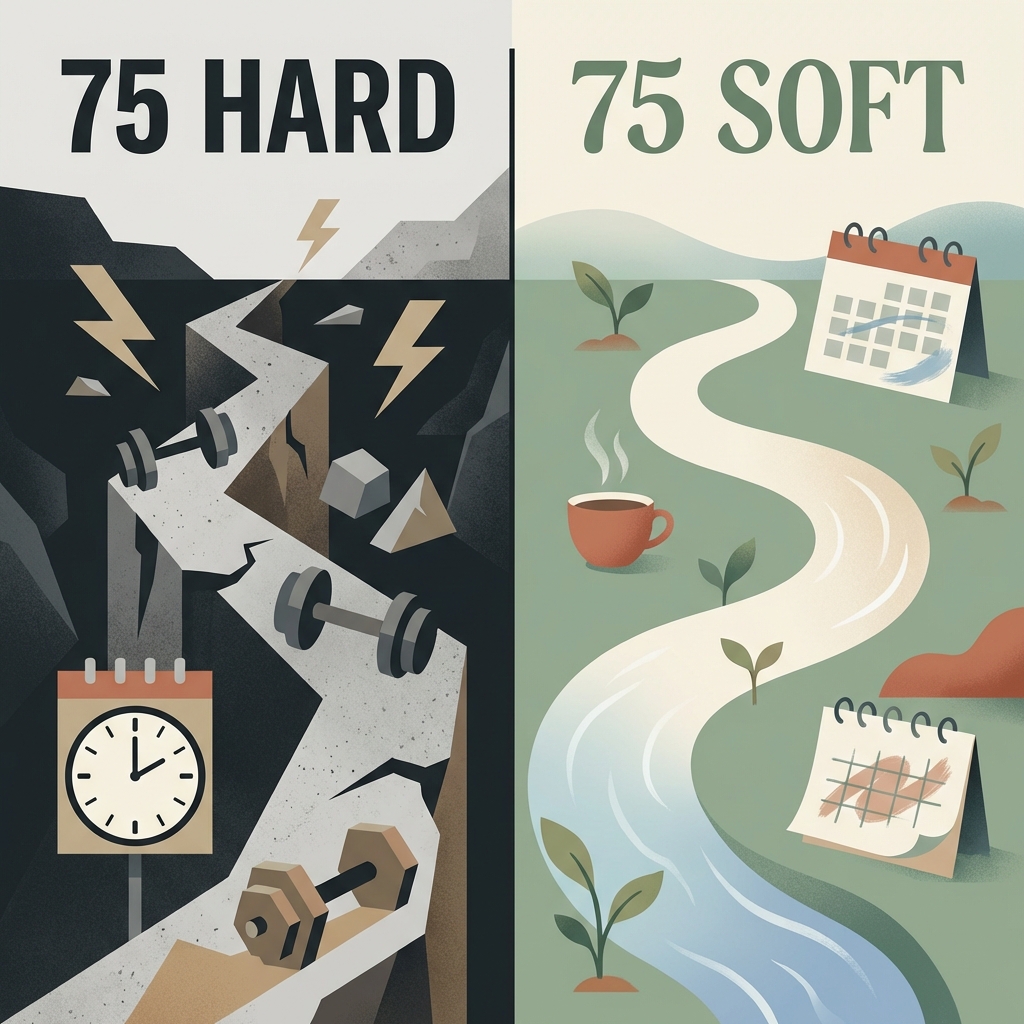
You've probably seen them everywhere: 30-day yoga challenges, 30-day meal prep challenges, 30-day workout programs. The "30-day" format dominates the wellness industry. So when you encounter 75 Soft and its 75-day timeframe, you might wonder: Is 75 days really necessary? Or is it just arbitrary?
The answer lies in behavioral psychology research—and it strongly supports the longer approach. Here's why 75 days may be the sweet spot for genuine, lasting habit formation, and how 75 Soft compares to the popular month-long alternatives.
The 21-Day Myth: Where Did It Come From?
You've likely heard that it takes 21 days to form a habit. This "fact" has been repeated so often that most people accept it without question. But it's largely a myth—and understanding its origin helps explain why 30-day challenges often fail.
The 21-day idea traces back to Dr. Maxwell Maltz, a plastic surgeon who noticed in the 1950s that his patients took about 21 days to adjust to their new appearances. He published this observation in his 1960 book Psycho-Cybernetics, noting it as a "minimum" timeframe for adjustment—not a magic number for habit formation.
The Misquote That Changed Everything
Maltz wrote that it takes "a minimum of about 21 days" for an old mental image to dissolve. Self-help authors dropped the "minimum" and "about," turning it into a definitive 21-day habit formation rule. This misinterpretation has shaped fitness marketing ever since—and it's why so many challenge programs are built around month-long timeframes.
The 66-Day Science: What Research Actually Shows
The most rigorous study on habit formation comes from Phillippa Lally and her team at University College London. Published in the European Journal of Social Psychology in 2009, this research tracked 96 people over 12 weeks as they attempted to form new daily habits.
The Findings
- Average time to automaticity: 66 days
- Range: 18 to 254 days, depending on habit complexity
- Simple habits (like drinking water): ~20 days
- Complex habits (like daily exercise): 84+ days
The key finding: automaticity—the point where a behavior feels natural rather than forced—took significantly longer than 21 or 30 days for most participants, especially for complex health behaviors.

Why 75 Days Works: The Science-Backed Sweet Spot
Given the research, 75 days emerges as an ideal challenge duration for several reasons:
1. It Exceeds the 66-Day Average
By extending 9 days past the average automaticity threshold, 75 Soft ensures that most habits have time to become genuinely automatic. Those extra days aren't filler—they're the difference between fragile new behaviors and embedded routines.
2. It Accounts for Complex Habits
75 Soft asks you to build multiple habits simultaneously: exercise, nutrition, hydration, and reading. Each of these is a complex behavior. The 75-day duration allows even slower-forming habits to approach automaticity.
3. It Survives Real Life Challenges
In 75 days, you'll likely encounter:
- At least 2-3 weekends with social events
- Work travel or vacation
- A minor illness or injury
- Stressful periods at work or home
- Holiday periods (depending on start date)
Practicing your habits through these challenges—not just during easy periods—is what creates resilient, lasting behaviors.
4. It Allows for Plateaus and Breakthroughs
Progress isn't linear. Most people experience enthusiasm in Week 1, struggle in Weeks 2-4, plateau around Week 6, and finally break through to genuine habit formation in Weeks 8-10. A 30-day challenge ends right when things get hard—before the breakthrough.
"The habit curve isn't a straight line. Most people quit right before the behaviors would have become automatic. 75 days gets you past that critical inflection point."
Comparing Popular 30-Day Challenges
Let's examine how 75 Soft compares to popular 30-day alternatives:
| Challenge Type | Duration | Habit Retention | Key Limitation |
|---|---|---|---|
| 30-Day Yoga Challenge | 30 days | Low (20-30%) | Ends before automaticity |
| 30-Day Plank Challenge | 30 days | Very Low | Progressive overload often too intense |
| Whole30 | 30 days | Low-Medium | Restrictive approach hard to maintain |
| 30-Day Squat Challenge | 30 days | Low | Single exercise focus |
| 75 Soft | 75 days | High (60-70%+) | Requires longer commitment |
Why 30-Day Challenges Have Low Retention
The problem with 30-day challenges isn't that they're bad—it's that they end too soon. Most participants experience:
- Days 1-7: Motivation high, novelty exciting
- Days 8-14: Reality sets in, enthusiasm wanes
- Days 15-21: The "valley of despair"—hardest period
- Days 22-30: Just starting to build momentum
The challenge ends right when habits are beginning to form. Without the structure, most people revert to previous behaviors within 2-4 weeks of completion.
The Plateau Breakthrough Effect
One of the most important reasons 75 days works is what I call the "plateau breakthrough effect." Here's what typically happens:
Weeks 1-2: The Honeymoon Phase
Everything feels possible. You're motivated, energized, and proud of making changes. Social media posts get likes. Friends encourage you.
Weeks 3-5: The Struggle
Novelty fades. The alarm goes off for your workout and staying in bed sounds much better. The excitement has worn off, but the habits haven't become automatic. This is where most 30-day challenges end.
Weeks 6-8: The Plateau
You stop seeing rapid changes. Weight loss stalls. Energy levels normalize. You might wonder if it's still "working." This is the most dangerous period—and it's right where 30-day challenges would have ended weeks ago.
Weeks 9-11: The Breakthrough
Something shifts. You realize you went to the gym without thinking about it. You grabbed water instead of soda automatically. The habits are becoming part of who you are.
The 75-Day Advantage
75 Soft takes you through the full cycle: honeymoon, struggle, plateau, and breakthrough. By Day 75, you're not just doing the habits—you've become the person who does them. That identity shift is what 30-day challenges rarely achieve.
From Behavior to Identity: Why This Matters
James Clear's research in Atomic Habits distinguishes between three levels of change:
- Outcome change: Changing results (losing 10 pounds)
- Process change: Changing habits (going to the gym)
- Identity change: Changing beliefs about yourself (being a fitness person)
30-day challenges typically produce outcome and process changes—but they're too short for identity change. When the challenge ends, the old identity reasserts itself.
75 days provides enough repetition for identity transformation:
- 75 days of exercise → "I'm someone who moves daily"
- 75 days of reading → "I'm someone who reads"
- 75 days of hydration → "I'm someone who takes care of my body"
These identity shifts persist because they become part of how you see yourself.
When 30-Day Challenges Make Sense
I'm not saying 30-day challenges are useless. They can be valuable in specific contexts:
Testing New Habits
If you're not sure whether you'll enjoy yoga, a 30-day challenge is a low-commitment way to explore. Just recognize that completion doesn't mean the habit is formed.
Kickstarting Momentum
A 30-day challenge can break inertia and build initial momentum. The key is having a plan for Day 31—perhaps transitioning to 75 Soft to solidify the habits.
Focused Skill Development
Challenges focused on learning (like "30 days of coding" or "30 days of drawing") work differently than habit challenges. The goal is skill acquisition, not automatic behavior.
Recovery Periods
After completing 75 Soft, a focused 30-day challenge (like a mobility challenge) can be a good next step that builds on established habits.
Combining Approaches: The Best of Both Worlds
You don't have to choose between short and long challenges. Here's a strategic approach:
The 30-75-30 Method
- 30-day exploration: Try different habits to find what works for you
- 75 Soft: Lock in the winners with the full 75-day commitment
- 30-day specialization: Add focused challenges that build on your foundation
Using 30-Day Milestones Within 75 Soft
Some people find it helpful to mentally break 75 Soft into phases:
- Days 1-30: Foundation phase—focus on consistency
- Days 31-60: Growth phase—increase intensity or variety
- Days 61-75: Mastery phase—refine and solidify
Celebrating Day 30 and Day 60 as milestones provides the psychological satisfaction of short-term wins while maintaining the long-term trajectory.

Ready to commit to lasting change? Start with our complete 75 Soft rules guide or learn how to build atomic habits that stick.