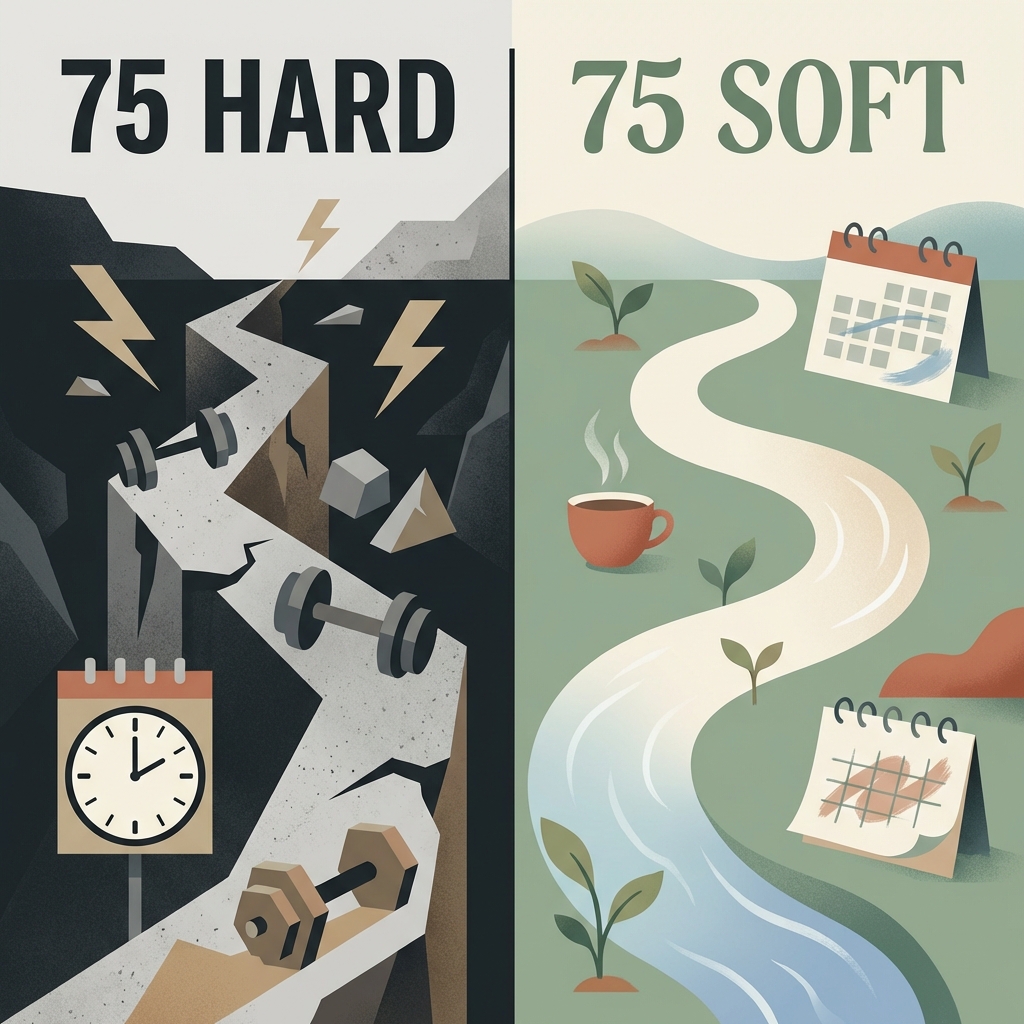
The debate between 75 Hard and 75 Soft has divided the fitness community since 75 Soft emerged as a gentler alternative. Both promise transformation, discipline, and habit-building—but they take radically different approaches. If you're wondering which one is right for you, this guide breaks down everything you need to know to make an informed decision.
I've spent months researching both challenges, speaking with people who've completed each, and consulting expert opinions from registered dietitians and mental health professionals. What I've found might surprise you: the "better" challenge isn't about which is harder—it's about which one you'll actually complete and sustain.
The Origins: How Each Challenge Began
Understanding where these challenges came from helps explain their fundamental differences in philosophy and design.
75 Hard: The "Mental Toughness Program"
75 Hard was created by entrepreneur Andy Frisella in 2019. He explicitly designed it as a "mental toughness program"—not a fitness or diet plan. The extreme requirements are intentional: Frisella believes that comfort is the enemy of growth, and that pushing through discomfort without compromise builds discipline that transfers to all areas of life.
The program gained massive traction through social media, particularly among people who thrive under all-or-nothing conditions. For Frisella's audience—entrepreneurs and high-achievers seeking an edge—the difficulty is the point.
75 Soft: The Community-Driven Alternative
75 Soft emerged organically from fitness communities who loved the concept of 75 Hard but found the execution unsustainable or potentially harmful. There's no single creator—it evolved through TikTok, Reddit, and fitness forums as people shared their modifications.
The guiding philosophy: sustainable habits matter more than perfect compliance. 75 Soft maintains the structured daily framework while building in flexibility for real life—rest days, social occasions, and mental health considerations.
Rule-by-Rule Comparison
Let's break down exactly how each challenge differs, rule by rule. This comparison is based on the most commonly accepted versions of each program.
| Rule Category | 75 Soft | 75 Hard |
|---|---|---|
| Duration | 75 consecutive days | 75 consecutive days |
| Daily Workouts | One 45-minute workout (can include active recovery) | Two 45-minute workouts (one must be outdoors) |
| Rest Days | One day per week of active recovery allowed | No rest days permitted |
| Diet Approach | "Eat well" with flexibility (80/20 approach) | Strict diet of your choice with zero cheats |
| Alcohol | One social drink per week allowed | Zero alcohol for 75 days |
| Water Intake | 3 liters (about 100 oz) daily | 1 gallon (128 oz / 3.78L) daily |
| Reading | 10 pages daily (any genre) | 10 pages daily (non-fiction/self-improvement only) |
| Progress Photos | Optional | Required daily |
| Failure Policy | Continue from where you are | Start over from Day 1 |
The Critical Difference: The Restart Rule
Perhaps the most significant distinction is what happens when you slip. In 75 Hard, missing any requirement means resetting to Day 1—whether you're on Day 3 or Day 72. This creates enormous pressure and, for many people, leads to complete abandonment after a single mistake.
In 75 Soft, there's no restart rule. If you have an imperfect day, you continue the next day. Progress accumulates; it isn't erased by imperfection.
The Math of the Restart Rule
If someone attempts 75 Hard and fails on Day 45, then fails again on Day 30 of their second attempt, they've exercised for 75 days total—yet they've "completed" zero challenges. With 75 Soft's approach, those same 75 days of effort would count as 75 days of progress toward lasting habits.
Health Implications and Expert Opinions
What do healthcare professionals say about these challenges? The consensus is clear—and it favors the more moderate approach.
Physical Health Concerns with 75 Hard
According to Cleveland Clinic, the 75 Hard program raises several red flags:
- Overtraining risk: Two daily workouts without rest days ignores fundamental recovery science
- Injury potential: Exercising through fatigue or minor injuries (to avoid restarting) can cause serious damage
- Weather exposure: Mandatory outdoor workouts in extreme heat, cold, or storms can be dangerous
- Hydration excess: A gallon of water daily may be excessive for smaller individuals
Penn State Health experts recommend starting with just 15 minutes of exercise daily, five days per week, and building up gradually—a philosophy much more aligned with 75 Soft than 75 Hard.
Mental Health Considerations
The mental health implications may be even more significant:
- Disordered eating triggers: Strict diet rules with no flexibility can activate or worsen eating disorders
- Exercise compulsion: The no-rest-days policy can foster unhealthy relationships with exercise
- All-or-nothing thinking: The restart rule reinforces cognitive distortions associated with anxiety and depression
- Shame cycles: Repeated "failures" and restarts can damage self-esteem
"Rather than testing your willpower and denying yourself with a stringent diet, the 75 Soft program suggests doing your best and making healthier choices—something that's easier for people to manage for the long haul." — Penn State Health
Why 75 Soft Is Often Recommended
Healthcare professionals generally view 75 Soft more favorably because it:
- Includes necessary rest and recovery
- Allows flexibility that prevents binge-restrict cycles
- Doesn't punish normal life circumstances
- Builds sustainable habits rather than temporary extreme compliance
Completion Rates and Success Stories
While official statistics don't exist, community surveys and social media analysis suggest significant differences in completion rates.
75 Hard Completion Rates
Estimates from Reddit communities and fitness forums suggest that only 10-20% of people who start 75 Hard complete it on their first attempt. Many people report multiple restarts before finishing—or giving up entirely.
The most common failure points are:
- Week 2-3: Initial enthusiasm fades, schedule conflicts emerge
- Week 5-6: Fatigue accumulates without rest days
- Unexpected events: Illness, travel, family emergencies
75 Soft Completion Rates
Anecdotal evidence suggests significantly higher completion rates for 75 Soft—perhaps 40-60% or higher. The built-in flexibility allows people to work around obstacles rather than being derailed by them.
Common 75 Soft success factors include:
- Rest days preventing burnout
- Social flexibility reducing isolation
- Continuation after imperfect days maintaining momentum
The Psychological Differences
The two challenges appeal to different psychological profiles and produce different mental outcomes.
75 Hard Psychology
75 Hard attracts people who:
- Thrive under extreme pressure and clear rules
- Want to prove something to themselves or others
- Have a history of excelling in all-or-nothing scenarios
- Are in a life phase that allows total focus on the challenge
When successful, completers often report increased mental toughness and confidence. However, the program can also reinforce perfectionism and black-and-white thinking patterns that extend negatively into other life areas.
75 Soft Psychology
75 Soft attracts people who:
- Have busy lives with responsibilities they can't pause
- Recognize that extreme approaches haven't worked before
- Value sustainable progress over dramatic short-term results
- Have mental health considerations that make rigidity risky
Completers often report improved self-compassion, better work-life balance, and habits that continue naturally after the 75 days end—suggesting stronger habit formation.

Who Should Choose Which Challenge?
Based on research and community experiences, here are guidelines for choosing:
Choose 75 Hard If:
- You have no history of disordered eating or exercise compulsion
- Your schedule and life circumstances allow for two daily workouts
- You specifically want to test your mental limits
- You've successfully completed extreme challenges before
- You have no underlying health conditions that require rest or flexibility
- You genuinely thrive under strict, no-exception rules
Choose 75 Soft If:
- You have family, work, or caregiving responsibilities
- You have any history of disordered eating or exercise addiction
- You're recovering from injury, illness, or pregnancy
- You've tried extreme approaches before with poor results
- You value sustainable habit-building over proving toughness
- You have mental health conditions affected by perfectionism
- You're new to fitness challenges
When in Doubt, Start Soft
If you're unsure which challenge is right for you, 75 Soft is almost always the safer starting point. You can always graduate to 75 Hard later if you want more intensity. But starting with 75 Hard and burning out can leave you worse off than before—physically, mentally, and motivationally.
Can You Switch Between Challenges?
Absolutely—and many people do. Here are common transition paths:
75 Soft → 75 Hard
If you complete 75 Soft and want more challenge, you can attempt 75 Hard knowing you've already built foundational habits. Your baseline fitness, hydration habits, and reading routine are established, making the harder program more achievable.
75 Hard → 75 Soft
There's no shame in "downgrading" to 75 Soft. Many people start 75 Hard, recognize it's unsustainable for their circumstances, and switch to 75 Soft. This isn't failure—it's intelligent adaptation.
Hybrid Approaches
Some people create their own hybrid: perhaps 75 Soft rules with no alcohol, or 75 Hard intensity but with allowed rest days. While purists might object, what matters most is finding an approach you'll actually complete.
Your Decision Framework
Use this framework to make your choice:
Step 1: Assess Your Life Circumstances
Can you realistically commit to two 45-minute workouts daily for 75 days? Do you have events, travel, or responsibilities that would require flexibility? Be honest—hope is not a strategy.
Step 2: Consider Your History
How have you responded to extreme challenges before? If you've completed them successfully and want another, 75 Hard might work. If you've repeatedly burned out, 75 Soft is probably wiser.
Step 3: Evaluate Your Goals
What do you actually want? If it's lasting habit change, 75 Soft's research-backed flexibility may serve you better. If it's proving you can endure extreme discipline, 75 Hard is designed for that.
Step 4: Check Your Mental Health
If you have any history of anxiety, depression, eating disorders, or exercise compulsion, strongly consider 75 Soft—or consult a mental health professional before attempting either.
Ready to start? If you've chosen 75 Soft, explore our complete rules guide or dive into the 10-week workout plan. If you're still deciding, read about all the challenge variations to find your perfect fit. Or learn why 75 days is the optimal challenge duration.